Showing posts with label ad copy. Show all posts

Saturday, November 18, 2017

When Bad Punctuation, Spelling and Grammar Happen to Good People

 I'm delighted for these students but to paraphrase the words of Inigo Montoya, "This headline does not mean what they think it means."

For heaven's sake, where was the copy editor? Managing editor? Reporter? Anyone?

What ever happened to reading your work before hitting "send" or going to print?

It seems that more and more, people are making grammar and spelling errors that are funny to many, cringe-worthy to multitudes, but also embarrassing for the perpetrators; in many cases, they show an ignorance to rules of grammar, spelling, and punctuation that should have been mastered throughout 12 years of school, not to mention college or grad school after that. It's getting so bad that HubSpot ran a blog article about this back in June. In fact, there are a lot of web pages dedicated to these writing snafus and I just found this Pinterest page devoted to these bloopers.

This need not be. Thanks to the internet, there are plenty of sites to use for doing a quick check on spelling (American vs. British English, online dictionaries) as well as grammar. Journalists and public relations/news release writers use the AP Style manual (I just looked to make sure it was in there, and yes, firsthand as an adverb or adjective is indeed one word!). Publications have editors and proofreaders (well, they should have them) as do ad agencies.

Have you read the wonderful book, "Eats, Shoots & Leaves: The Zero Tolerance Approach to Punctuation" by Lynne Truss? Please do. Do you check grammarly.com? Go ahead, I dare ya. Or have a friend or trusted colleague read over your work before it's published. Please. There are plenty of resources available if you're not sure, folks—but if you are a writer, please, in the name of all things sacred, learn to spell and punctuate correctly, and check your work before it's printed, published or recorded.

Here's another goody for you, from a local restaurant:


Now, I know the owners meant that the place was "formerly" Giovanni's, since they changed the name (the tip-off). They did not mean that it is "formally" known as Giovanni's as in, "officially" and then misspelled "formally." I'm sorry, but the Grammar/Spelling bitch inside me says this is simply not acceptable. A friend of mine who is a printer said that printers may sometimes bring up suspected errors to clients if they have the time to do so (if they actually recognize the error, right?) but often they assume it's how the client wants it. I sure wish this restaurant owner's sign printer had noticed the error and corrected it.(I have fingers crossed that "cappuccino" is spelled correctly on the menu and that, here in New Jersey, the restaurant does not serve "expresso" but that's for another day.)

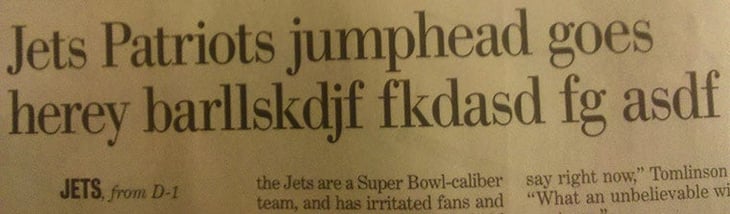
I believe we can partially blame spell checking programs for this social ill. I mean, why bother to learn how to spell when the computer will (not always) correct your mistakes? I also blame the societal meme about how no one has time to read anything, everyone is skimming, blah blah blah de blah ... I don't believe it and it shouldn't matter. That said, I would like to know who was able to read and decipher this nugget:asdf.jpg
Sunday, September 1, 2013

Missing the Old Days

Summer is winding down, my daughter (only child) is now at college, and I find myself feeling quite nostalgic for my college days. I did not even love where I went to college but no matter . . . knowing about all the experiences my daughter will be experiencing over the next four years makes me yearn for that simpler time (that, at the time, did not always feel so simple!).

Then my thoughts turn to my early days in advertising, as an aspiring and then junior copywriter. Ah . . . typing on an IBM Selectric II; brainstorming with my art director in our offices, cracking each other up with awful headlines and ad concepts until we got a few we liked, then layouts drawn with black marker on big pads of paper; art directors with heads buried in lucigraphs as they resized images, and waiting three days to get a proof back because it had to be typeset and the PMT (photo mechanical transfer) had to be created (remember veloxes?). Graphic artists knew how to paste up type and the typesetting machine we got at McDonald & Little took up the whole break room!

Video and audio tape. 7-1/2 ips. 3/4", 1" or 2" for broadcast -- all these numbers meant something at one point. You could hold your work in your hands. You schlepped a portfolio around with your print work and your reels.

Today it is quite different in so many ways, from the way we work to how the work is produced. Now we talk about MP3s and podcasts, and send links to websites written or digital portfolios. Spots are edited on desktops, ad layouts are done in minutes, changes nearly instantaneous. My skills have expanded and my work assignments broadened to meet the demands of today's clients and technology.

But the work is different for me in other ways as a freelance copywriter. I'm a journeyman, I go where I'm needed and generally work on my own, separately from the art director or designer until we meet up later on to align our designs, copy, or concepts. It's a backwards process but seems to be the way these days. Sometimes we end up at the starting line together -- a more cohesive way to produce good creative. But not always. And I don't always see the final version of work I've done--assignments often disappear into the vapor or I forget to ask because I'm on to the next project.

As nostalgia for the "good old days" seeps into my consciousness, I miss:
  •  Sitting in each other's offices with pads and pens and ideas bouncing around the room. 
  • Working very late and sleeping on my creative director's couch because the meeting was early the next morning. 
  • The sound of the keyboards in writers' offices.
  • The presentation meetings with our group head and creative director, getting them to sign off on our ideas to present to the client. 
  • Working with great voice talent to create radio spots or going on shoots for TV commercials.
  •  Storyboards for commercials rendered rough in the office, then returned with the artistic flourishes of the storyboard artist. 
  • Acting out radio scripts for other creatives before sharing with the client. 
  • And humoring the account guys who wanted creative to follow "the research" (nice try, guys). 
Good times.


My former group head sent me a slide last year of me and a Charlie Chaplin impersonator from a shoot we did for a bank commercial a million years ago. Two framed animation cels (hand-drawn and hand-painted) from a Cookie Crisp commercial I wrote still adorn the wall above my office. Treasured memories.


Ad agencies were not public relations agencies and the lines had not yet blurred as they are today between advertising, marketing, and PR. There was no internet yet nor social networks. The day I was leaving my job at McCaffrey & McCall, some new "computerized typewriters" were being delivered to the secretaries--the first personal computers the agency was investing in. Exotic.

The unfettered creativity, the mistakes, the bloopers, the great lines and sizzling copy (the ones that the clients didn't buy and the ones they did), the jingles, the learning curve, and the feeling that all was right with the world. That was then, this is now--byline articles and blog posts, website copy, press releases, collateral material, and yes, even the occasional ad or TV or radio spot. And I'm so happy to be a part of it still! 

Tuesday, October 2, 2012

You Get What You Pay For

Why is it that plumbers, electricians, and handymen are not questioned about their fees and consumers pay them handsomely for their services?

How is it that lawyers charge several hundred dollars an hour to share their expertise, and clients pay for that without querying the attorneys about their qualifications that support this rate? (Dear Esquires, I am not picking on you, really - this is just to make my point.)

What is it about freelance copywriters that makes everyone think they can bottom feed and get away with it (or at least try)?

Can you hear me sighing now?

This issue has popped up on several LinkedIn groups that I'm a member of so I know I'm not the only one confronting this (although I am happy to report it is not a frequent problem at StarrGates Business Communications).

When it comes to your company's communications, don't you want a professional to help craft your message, write your copy, position you with crisp, polished text that sells? In our field, you most certainly get what you pay for. The range of fees copywriters charge is pretty broad and somewhat informed by geography. But all things being equal, a seasoned pro will work with you to deliver well-written copy in your brand voice, in ways that are meaningful to your audience.

You might be able to get this for $25 an hour or even $35 when you hire a junior copywriter but please understand that experienced professional copywriters charge more than this and will deliver a lot for the money and therefore are worth more. I am shocked that placement firms that specialize in creatives (such as copywriters and art directors) are offering these low rates to independent contractors (like me) --all the more so because this is what I was getting DECADES ago. This is not good for the industry and brings down the whole earning curve. Toss in the bloggers who will accept $10 or $15 to write blog posts and now we're really sinking low. Welcome to the "new economy?" I say to hell with that!

Freelancers rely on billable hours to earn their livings, just as attorneys do. Freelance copywriters must be mindful of the time they spend servicing their accounts, just as your mechanic does when he's  installing a new transmission (and bills you for time and materials). Freelance copywriters pack a lot into their hourly rates or their flat fees for your project. Our rates are not strictly for the time it takes to write or for the actual finished product (if billing a flat rate) but for all those ancillaries clients don't always think of.


As a professional freelance copywriter, I have to factor in:
  1. Client meetings. Our time is valuable, people--every bit as valuable as yours. If I am not sitting in front of my computer writing but rather, am sitting in meetings going over your copy and discussing revisions, I am not creating (and therefore, billing). Although I do not charge for an initial client meeting/call to discuss copy needs, copy direction, etc., I have to be compensated for the time I spend servicing your account. I think I'm pretty generous with my time and I don't nickel-and-dime anyone (and in fact, I give away quite a bit of time). You might not see this should-be-billable time broken out on an invoice, but it's in there. If you want me to sit through four hours of meetings to go over the copy again, or you want me to travel several hours round trip to visit an account, I have to be paid for this!
  2.  Research. I think I'm pretty smart . . . but not so smart that I can whip out website pages, blog posts, or brochures about industries I know nothing about until I do the research. I have been hired numerous times as a ghost writer to produce expert byline articles about fields in which I am not an expert at the outset, and am delighted to learn about during the writing process. I like researching and learning and becoming a pop-up expert about a diverse array of topics and industries. Even if I am writing about something I already know, I want to research what your competition is doing or look for something new in your field to talk about if it's relevant. This takes time.
  3. Scope creep. This is the bane of all creatives, when clients go around and around with more revisions than the original contract calls for. I'm not talking about a minor tweak here and there after copy has been approved, or discovering a typo that was missed during proofreading; what I refer to here is more involved rewrites or, after approval, several requests for revisions that require more than a five-minute change. Again, I am generous with my time and will often overlook minor "violations" but if the contracted fee includes one round of revisions, after that you're on the clock for an hourly rate. So why are you complaining when you get the final invoice? You signed the contract!
  4. Continuing education. Even if it's not formal such as taking classes or going for certifications, a good copywriter must always be learning, especially in today's quickly changing world. Copywriters who want to stay relevant must stay abreast of the latest trends, the new media platforms, the shifts in business, corporate, and marketing communications. We read a lot, we pay attention to the world around us, we figure out how to incorporate what makes sense for our clients into our work (and help them build their businesses which is what we are hired to do!). 
  5. Experience. I've written for a lot of different types of accounts. I have worked with all sorts of people. I can handle account management as well as creative concept and execution. I can write for advertising as well as public relations which are two different disciplines. I understand how to work with art directors and graphic designers. I have developed a level of diplomacy and professional tact that most 20-somethings simply do not possess yet. This is my experience. And you get what you pay for.

Tuesday, July 10, 2012

Say It, Don't Spray It!

Why is it that so many advertisers feel the need to cram every single message they have into one ad? I'm sure someone told these businesses that with their limited advertising dollars, it's best to use the shotgun approach, put all their selling points out there, and see what people respond to.

Uh, not a great idea. Really, I would not give you a bum steer here. Keep your ad copy simple. If you cannot afford to run more than one ad for something, resist the temptation to squish every sales point into the piece. Save it for your website where you can break down your message into distinct pages.

These best approach is to really hone your message, cough up the money to run enough ad insertions or radio or TV spots to drive home what you are trying to say. You can say it in many different ways - that's the beauty of an ad campaign. But you simply cannot sell your audience on more than a point or two within one piece of (well-written) communication. No one will know what you are really trying to say if you spray them with too many messages. Especially in this age of over-communication, media barrages, too many emails, etc., now more than ever, simplicity is golden.

In a print ad, the headline and leave-behind line, coupled with a strong visual, are what will grab readers' attention. These need to be short and to the point and speak to your readers' needs or, as some marketers put it, their pain points (in other words, how are you solving their problem). If you are a financial services firm that specializes in a niche investment product, and cater to a certain segment of the investing population, you have to distill your message to the one thing these potential clients need to know; don't waste their time with lots of ancillary information that has nothing to do with "here is this great product you need to know about ... and here's why." The ad copy can provide more detail but the headline and leave-behind line really need to sum up why the audience needs to contact you for more information or to open an account.

The challenge is greater in radio, where people are not leisurely reading, stopping to rip out an ad or jot down a phone number. They are driving, or listening while working, and might not have the chance to stop everything to fully grasp your vital statistics. As "the theater of the mind," radio spots must paint a clear picture of what you are selling in a very different way. The spots must be uncluttered in order to grab attention, maintain attention, and eventually lead to the desired result. Screaming announcers, too many sound effects, boring announcer reads, too much rambling copy ... these all invite tuning out, not tuning in. Keep the message simple and clear, make it fun if that's appropriate, and give a clear call to action. As with any kind of media buy, the spots need to not only be well written but also be well placed (buy the right programs, time slots, frequency) to make an impact.

It's not always easy to key in on just one message but if you think about the ad campaigns that are not only memorable but also effective, you'll find a common element among them: one clear message conveyed in different ways, across different media perhaps or over the course of many years. You can only effectively sell one quality at a time through your advertising copy: quality, social responsibility, saves money, saves time, builds wealth, nurtures problem students, pamper yourself or others, feeds the soul/spirit/belly, adventure, fun, family (and on and on).  Working with a professional copywriter or a marketing expert can help you figure out what you need to communicate and help you avoid spraying your target audience with too much extraneous information.