Showing posts with label The Copy Block. Show all posts

Saturday, November 18, 2017

When Bad Punctuation, Spelling and Grammar Happen to Good People

 I'm delighted for these students but to paraphrase the words of Inigo Montoya, "This headline does not mean what they think it means."

For heaven's sake, where was the copy editor? Managing editor? Reporter? Anyone?

What ever happened to reading your work before hitting "send" or going to print?

It seems that more and more, people are making grammar and spelling errors that are funny to many, cringe-worthy to multitudes, but also embarrassing for the perpetrators; in many cases, they show an ignorance to rules of grammar, spelling, and punctuation that should have been mastered throughout 12 years of school, not to mention college or grad school after that. It's getting so bad that HubSpot ran a blog article about this back in June. In fact, there are a lot of web pages dedicated to these writing snafus and I just found this Pinterest page devoted to these bloopers.

This need not be. Thanks to the internet, there are plenty of sites to use for doing a quick check on spelling (American vs. British English, online dictionaries) as well as grammar. Journalists and public relations/news release writers use the AP Style manual (I just looked to make sure it was in there, and yes, firsthand as an adverb or adjective is indeed one word!). Publications have editors and proofreaders (well, they should have them) as do ad agencies.

Have you read the wonderful book, "Eats, Shoots & Leaves: The Zero Tolerance Approach to Punctuation" by Lynne Truss? Please do. Do you check grammarly.com? Go ahead, I dare ya. Or have a friend or trusted colleague read over your work before it's published. Please. There are plenty of resources available if you're not sure, folks—but if you are a writer, please, in the name of all things sacred, learn to spell and punctuate correctly, and check your work before it's printed, published or recorded.

Here's another goody for you, from a local restaurant:


Now, I know the owners meant that the place was "formerly" Giovanni's, since they changed the name (the tip-off). They did not mean that it is "formally" known as Giovanni's as in, "officially" and then misspelled "formally." I'm sorry, but the Grammar/Spelling bitch inside me says this is simply not acceptable. A friend of mine who is a printer said that printers may sometimes bring up suspected errors to clients if they have the time to do so (if they actually recognize the error, right?) but often they assume it's how the client wants it. I sure wish this restaurant owner's sign printer had noticed the error and corrected it.(I have fingers crossed that "cappuccino" is spelled correctly on the menu and that, here in New Jersey, the restaurant does not serve "expresso" but that's for another day.)

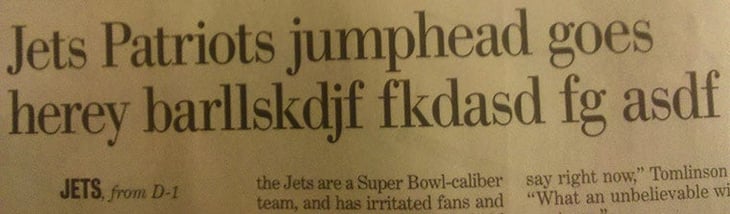
I believe we can partially blame spell checking programs for this social ill. I mean, why bother to learn how to spell when the computer will (not always) correct your mistakes? I also blame the societal meme about how no one has time to read anything, everyone is skimming, blah blah blah de blah ... I don't believe it and it shouldn't matter. That said, I would like to know who was able to read and decipher this nugget:asdf.jpg
Tuesday, November 1, 2016

How Content for Home Appliance Brands Can Put the Spin on Engaging Users


Content is the platform by which manufacturers can tell their stories, answer consumer questions, and demonstrate their products to potential buyers. It presents multiple opportunities across media for companies to interact with consumers (and potential customers) and can provide a space for customers to interact with each other in the social space. This collaboration in turn expands a company’s online presence, polishes its reputation, and boosts sales. All the better when content is part of an integrated marketing mix, as with home appliance manufacturer Whirlpool.

Home appliance manufacturers have ample opportunities and formats to engage target consumers through content. For example, rather than just talk about machine features, Whirlpool has used storytelling to convey the benefits of its products. This content (through TV spots, website content and print advertising) draws in consumers with stories that relate to their concerns.

Print ads and television commercials can drive users to social media and websites, where niche marketing messages can live. Online videos that tell relatable stories easily demonstrate product uses and features (and are easy to share with other users). In the case of home appliances, these can be about dishwashers, washers and dryers, ovens and cooking ranges. This video content can be written to address specific niche markets (home chefs who want to know how the cooktop will help them look like Food Network stars, teenagers concerned about how their jeans will wash). Microsites on the brand’s parent website can continue the conversation with more videos, FAQs, and case studies.


Touting product benefits without overtly promoting product is a vital part of a successful content marketing effort. This makes social media an excellent place to talk directly to consumers via targeted informational posts that create an open online community. For example, consumers can tweet questions about how to use a product or post something to a company’s Facebook page, giving the brand an opportunity to “talk” to potential customers and become a trusted resource for them.


Engaging case studies/product usage stories can make for great social media fodder, along with links to the product website and its additional content. In Whirlpool’s case, its Institute of Fabric Science enables consumers to ask for help with issues related to the company’s appliances but not necessarily about the actual products. Questions about how to wash or dry something—unrelated to Whirlpool’s products—are answered by corporate representatives and this content in turn positions the company as a trusted brand.

If you market home appliance brands, think about how content can be used to engage your target audience. Videos for product demos, FAQ sheets, online forums for product discussions, social sharing of appliance “wins” from happy consumers are all ways that content puts a positive spin on customer engagement. 

Images courtesy of WikiMedia Commons

Sunday, May 10, 2015

Making the Most of Your Post-Event Email Marketing (Or How Not to Piss Off Other People Who Did Not Meet You There)


As noted on my LinkedIn post, I recently attended a conference sponsored by an organization of which I am a long-time member. Within a few days of the event, I received three emails from other attendees saying how nice it was to meet me there, along with a sales pitch about how they might able to help me or my clients with their products/services.

This would have been acceptable had I actually met them; I do not even know who they are (and I know a lot of other organization members)!

This really pissed me off and gave me three reasons to scratch my head over these people's email marketing process (and etiquette).

Warning: Before you send out a followup email or marketing message to some list you downloaded or  pulled together on your own, be very careful what you say, and be very mindful of who you are saying it to!

The form letters landed like lead balloons in my inbox, rather than as effective lead generation tools. These were not auto-generated responses to a request for more information (which would have been welcomed as timely followups). These were three emails by three people who are now a lesson about what not to do in marketing (digital or otherwise). Here are some ways those ill-conceived emails could have been better conceived and executed:

Create different lists for your message. Make one for fellow attendees you don't know and another for those who you actually did meet. Email marketing solution such as MailChimp, Constant Contact, aWeber, emma, etc. make this easy to do and will show recipients that you approached your marketing effort with  a grain of consciousness (since it will lead to tip #2).

Form letters can have different forms. Form letters are expedient, but the openings and closings should be modified for your different target recipients. The boilerplate openings of all three emails reflected a lack of thought about who the email was going to--an immediate turn off. If you are sending marketing communication that starts with "It was nice to meet you at ..." make sure you actually met the recipient. It is easy enough to revise the opening and closing copy for a list of fellow attendees who you did not meet but would like to.

Suggest instead of selling. I did not know the senders and had no need for or interest in whatever they were selling. However, had they used the email to provide some value to me, I might have given them a chance. There are ways to promote your products or services without being overtly promotional (the foundation of content marketing). For example, you can mention what you do and then direct the reader to a great resource, or provide a helpful tip. Had I seen any of that in the bodies of the emails, my annoyance at the bad copy choice up front might have been mitigated and given me a reason to pause before hitting "delete." At the very least, I'd have been more likely to remember the senders as professionals who want to help rather than sell.


Good email marketing practices.

The one thing that was right about these three emails was that the senders clearly stated the connection (the conference) so at least it was not obvious spam. If you get a list as part of a sponsorship or pull together your own, make sure to identify right at the top why the person is getting your email. Oh ... and just because I handed you a business card at a networking event does not mean I just subscribed to your e-newsletter! Please ask people in advance if they'd like to be added to your list.

If you need help crafting an email marketing message that provoke unnecessary rants among your recipients, ask me (caryn@starrgates.com) or a marketing communications professional that you work with. We'll keep you on those recipients' good sides!

Wednesday, January 21, 2015

When it Comes to Copywriting Clients, One Size of Writer Does Not Always Fit All

Remember Johnny Cochran's famous line about the glove during the O.J. Simpson murder trial? He had a point.

As a copywriter I consider myself a generalist--no particular industry/area of expertise, able to write about a broad range of topics and for a variety of industries or fields of endeavor with a few exceptions. But as general as I am, and as many clients I am able to work with, I have to say that sometimes, you just can't please 'em all. And sometimes, that one-writer-fits-all-clients simply doesn't fit.

I was contacted several months ago by a lovely person who is starting a new endeavor with a business partner. Could I write the copy for their new website? Sure, would love to, sounds great. But it wasn't.

Aside from the fact I did not adhere to my own process for writing website copy (having the client complete a questionnaire to gather necessary information/input, provide competitor websites as reference and identify competition in the marketplace), our writing relationship has teetered on disastrous. I blame myself for not managing the process and for not stepping out of it in time. It simply was not a good fit. We got stuck in a morass of confusing messages, stream-of-consciousness input, direction that shifted a few times; the client did not even have a company name when I dove into the project. After four drafts and about four hours of phone time and copy review, I gave up. I could not for the life of me capture their voice--the heart of the problem, I believe. I was lost in a sea of too many changes and could not find my way back to their USP, their brand promise, their mojo.


What Would Donald Trump Have Done?
What I should have done, after the second go-round, is politely fire myself from the project. I have since done so, asking a colleague to handle any further edits because at this point, I can't see straight! (The website developer has had similar issues with the client--they don't know what they want until they see it, many revisions, no clear direction ...)

Because it is so important to me to have happy clients, I did not charge her for a lot of the work. She paid me up front to write four pages of copy, which was the original scope of the project; I'd written two others and edited (heavily) an additional two pages at no charge since I could see this was not going so well (although I have to say, to their credit, they have been very gracious and kind on the phone). After a point I advised the client to rewrite what I gave them in the way they wanted and I'd tweak and edit it to make sure it reads well. I was gratified to see they did use some of my copy throughout, and I gave them back their edited pages. At this point I have no clue where the project stands and I'm afraid to ask. But I am relieved to not suffer through any more changes and I am betting they're also relieved to not have to explain, once again, what they are looking for that they aren't seeing on the page.

So word to me and to the wise: If you're not a good fit for the client or the copy, move on! Replace yourself with someone who is a better fit, and you'll all be happier. I know I am.

Sunday, May 12, 2013

Twenty Great Reasons to Write and Publish a News Release

In my last blog post (which is too long ago, I admit that), I wrote about the downfall of businesses who think all their news is fit to print.


Honestly, sweethearts, it's not.

But it is not all that difficult to find reasons to communicate with the press (which in this case is not limited to print journalism--although many people on LinkedIn have argued that a press release is something that goes to "press" in traditional print way, rather than a news release that is sent to all news outlets. Whatever).

A news/press release can be about a lot of topics or matters related to your company or practice but should resonate with prospective readers, viewers, listeners (there, I've covered all ways to consume the news -- print, video/televisions/online, radio/podcast. Anything else?). 

Aside from announcing a new product or service you offer, which is true news (especially if it has real merit to your audience), here's a far-from-exhaustive list of (twenty) reasons to put out a news release about your company:

1  Announcing your new company website or significant upgrades to your existing website--and how they help your customers.
2.  Involvement with charity work; community service earns press and positive relations with the public. 

3.  Results or findings of a new study or research in your industry or field.
4.  Useful tips related to your product or service (without being overtly self-promotional).

5.  Forecasts about your industry or upcoming changes in your field that will affect consumers.
6.  Comments on current events or trends that relate to your industry.
7. Receiving an award -- this can be an employee, manager, owner, or the company. Share the good news!
8. An offer of a free downloadable white paper or e-book that benefits your audience; people love free information.
9. Adding new employees or opening a new office/location.

10. Saying goodbye to long-term employees who are retiring -- nice reason to craft a feature release.
11. Your office is hosting a special event or educational webinar or seminar.
12. Announce a reorganization or a renaming of your business.
13. Somewhat related, announcing the rebranding of your business (could be a renaming and corresponding marketing overhaul, or a periodic rebranding to refresh and renew how customers see you).
14. Community events your company is sponsoring, from high school fundraisers to Little League teams to social action endeavors.
15. Marking a milestone anniversary for your business (great way to include a retrospective of important business accomplishments or contributions over the years).
16. Gaining a big-name client or inking a big deal (as long as it's OK that this is public knowledge).
17. Presenting at an industry conference, exhibiting at a trade show, or sponsoring a program.
18. Crisis communications -- responding to negative press about your company, product, or service; managing your reputation with your public (where the rubber meets the road in public relations).
19. Making an appearance on a talk show or participating in an expert panel, from internet radio to television interviews to business interviews in the newspaper. All good.
20. Major financial or structural changes in your company-- merger or acquisition, going public, expanding overseas.

What are some of the reasons why your business has issued a press release? Feel free to share them in the comments box.