Showing posts with label headlines. Show all posts

Saturday, November 18, 2017

When Bad Punctuation, Spelling and Grammar Happen to Good People

 I'm delighted for these students but to paraphrase the words of Inigo Montoya, "This headline does not mean what they think it means."

For heaven's sake, where was the copy editor? Managing editor? Reporter? Anyone?

What ever happened to reading your work before hitting "send" or going to print?

It seems that more and more, people are making grammar and spelling errors that are funny to many, cringe-worthy to multitudes, but also embarrassing for the perpetrators; in many cases, they show an ignorance to rules of grammar, spelling, and punctuation that should have been mastered throughout 12 years of school, not to mention college or grad school after that. It's getting so bad that HubSpot ran a blog article about this back in June. In fact, there are a lot of web pages dedicated to these writing snafus and I just found this Pinterest page devoted to these bloopers.

This need not be. Thanks to the internet, there are plenty of sites to use for doing a quick check on spelling (American vs. British English, online dictionaries) as well as grammar. Journalists and public relations/news release writers use the AP Style manual (I just looked to make sure it was in there, and yes, firsthand as an adverb or adjective is indeed one word!). Publications have editors and proofreaders (well, they should have them) as do ad agencies.

Have you read the wonderful book, "Eats, Shoots & Leaves: The Zero Tolerance Approach to Punctuation" by Lynne Truss? Please do. Do you check grammarly.com? Go ahead, I dare ya. Or have a friend or trusted colleague read over your work before it's published. Please. There are plenty of resources available if you're not sure, folks—but if you are a writer, please, in the name of all things sacred, learn to spell and punctuate correctly, and check your work before it's printed, published or recorded.

Here's another goody for you, from a local restaurant:


Now, I know the owners meant that the place was "formerly" Giovanni's, since they changed the name (the tip-off). They did not mean that it is "formally" known as Giovanni's as in, "officially" and then misspelled "formally." I'm sorry, but the Grammar/Spelling bitch inside me says this is simply not acceptable. A friend of mine who is a printer said that printers may sometimes bring up suspected errors to clients if they have the time to do so (if they actually recognize the error, right?) but often they assume it's how the client wants it. I sure wish this restaurant owner's sign printer had noticed the error and corrected it.(I have fingers crossed that "cappuccino" is spelled correctly on the menu and that, here in New Jersey, the restaurant does not serve "expresso" but that's for another day.)

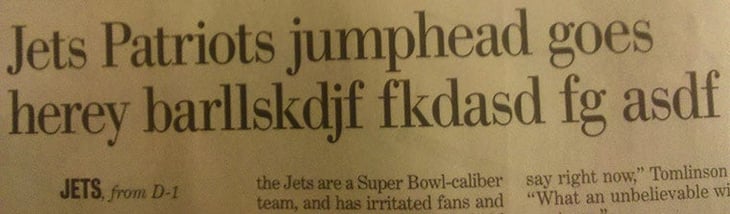
I believe we can partially blame spell checking programs for this social ill. I mean, why bother to learn how to spell when the computer will (not always) correct your mistakes? I also blame the societal meme about how no one has time to read anything, everyone is skimming, blah blah blah de blah ... I don't believe it and it shouldn't matter. That said, I would like to know who was able to read and decipher this nugget:asdf.jpg
Wednesday, October 15, 2014

Writing a Press Release? AP Style Matters

Writing a professional news release that the media outlets will take seriously is serious business, but it's not difficult. I've written before about making sure your news is actual news, that it is something the press and/or the listeners/viewers/readers will want to know about, as well as reasons to write a press release. 

Here are a few tips on how to write a press release the way a public relations writer would do it, with adherence to AP Style (the Associated Press Stylebook is readily available and is an excellent resource/guide for all matters of news-related reporting).


NOTE: These days, being the era of the digital and SEO press release, you should make sure to include keywords in your headline and in your supportive subhead that are also included in the body of your release.
That being said, here are some handy helpers and this list is by no means complete.

1. Give the editor what she needs to know in the Five Ws: who, what, where, when and why. Pack this information in the top part of your press release in case the very busy editor or reporter who is reading it is skimming and needs to move on to the next 1000 in her inbox. 


2. Get to the point quickly--don't make anyone read a few paragraphs before they figure out what your news is. Your headline and supportive subhead should telegraph the main premise and key talking points and your Five Ws should follow as immediately as possible. 

3. Titles are not always capitalized! GRRR ... this one always makes me just this side of loony. Clients always think a job title is capitalized. I have no idea where this misconception comes from. In a press release, the person's title (unless it is honorific or formal) is only capitalized when it precedes the person's name (Principal Figgins, Executive Director Caryn Starr-Gates) and is lower case after the name (Figgins, principal of McKinley High School or Caryn Starr-Gates, executive director of a whole lotta nuthin'). 

Formal titles, such as Senator, President, Princess are capitalized and appear before the person's name. There is a lot to read up on in the AP Stylebook about this.  


 4. You only use a person's full name the first time it appears, after which you use only the last name (usually; a few exceptions exist). So when I write about Dr. Arnold Pepper (that's Dr. Pepper's first name, right?) I would write, "Dr. Arnold Pepper, the lead scientist on the soft drink project ..." and later on I would write, "Pepper reported that Starr-Gates said she felt there was something really yucky about that soda and that she always prefers seltzer."

5. Write out some numbers, use digits on others. All ordinal and cardinal numbers first through ninth and one through nine are written out; move to numerals at 10th and 10.

6. Don't use first person. It's not "I" and "we" unless those are used in quotes in the story. It's news, written in the third person. Using first person will immediately tell the recipient, "I'm an amateur." 


7. Months that have more than five letters in them should be abbreviated. See the AP Stylebook for how to abbreviate those pesky long ones.

8. Postal abbreviations for state names (and the way they are written) are not the correct state name abbreviations for news releases. Some are the same, as it turns out but not all. Writing a letter to grandma in Tennessee? Write TN on your envelope but if you are talking about news in that state, write Tenn.

9. Spell correctly and punctuate correctly. Proofread that release before you hit "send." Remember that in American English, commas and periods go INSIDE the quotation marks. 

Although it makes me sad, serial commas are not used (I love me some serial commas). This is not to say that your feature article or book that you are writing according to another manual of style (hello, Chicago!) should not be peppered with serial commas; just not in your AP-style news release.

10.  Most book /magazine titles are in quotations. Don't italicize these. And not everything is put in quotes (reference material for example). Look it up in the "AP Stylebook."

11. Give the document some space. Many people double space their press releases, a throwback to the days of old when releases were mailed or faxed and editors needed room to edit. I usually space my documents at 1.15 to make them easier to read.
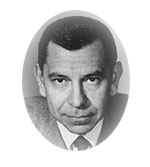
Joe Friday
12. Make sure your facts are straight. No sense making stuff up and then get caught in a lie or in spreading misinformation. You'll get blackballed in no time! If you know who this dude is and why I stuck his photo here, feel free to share that in the comments.

Here's a final tip: hire a professional writer to help you strategize, develop a newsworthy angle or bring out your real story, and write a professional, AP-style press release that won't be deleted before it's read! 

If you'd like me to review something you're working on, send it to caryn@starrgates.com.


  • Cover the five Ws: Who, What, When, Where, and Why. A press release functions as the hook to get an editor's attention. However, even if you have her attention, if you do not cover the necessary information, she will still find something else to print. The five Ws tell the editor the importance of the information presented.
  • 2
    Start with your main point. In journalistic writing, the main point, or overall topic, needs to be at the beginning. If the editor has to dig for it, he will find some other press release to print. You can also underline your main point by including a sample headline.
  • 3
    Look carefully at your use of dates and numbers. For example, ordinal numbers first through ninth have to be spelled out, while anything 10th and over uses numerals. the same applies for cardinal numbers one through nine, with 10 and higher written as numerals. Dates and years use numerals. All months with more than five letters, such as January, are expected to be abbreviated.
  • 4
    Go over your punctuation. It is important to remember to use one space after the period. Also commas and periods go inside of quotation marks, and serial commas are not used. That is, if you have a list of items, you do not need a comma before the last item: "This is a list of one, two and three items." Some writing styles do require a comma after the "and."
  • 5
    Check names and titles. The first time a person is introduced, you must use her first name and full title. Formal titles, such as President or Senator, must be capitalized and appear before the person's name. Informal titles such as deputy secretary of government agency are in lowercase and can appear either before or after a person's name. After first use, only the last name is necessary, except in cases where two people have the same last name or the name is mentioned in a direct quotation.
  • 6
    Double check and double space. When you finish writing your press release, double space the body of the release in order to give the editor space to edit the piece as necessary. Also, double check all your facts, including grammar and spelling, to ensure you are putting the best possible face on your company.


  • Read more : http://www.ehow.com/how_8029607_write-release-proper-ap-style.html

    Friday, May 25, 2012

    What the Heck is a Copywriter Anyway?

    A blog post by a fellow copywriter from the U.K. inspired me to write this entry today. The questions of "What do you do?" or "What is a copywriter?" are not unusual.

    First of all, I am not a lawyer who works with copyrights. Copywriters work with copy--with text that promotes and sells in some fashion. They come up with concepts to convey the sales message, in tandem with the art director who conceives the visuals that complete the website, TV commercials, or print project. Then they write the words that speak to that concept. It used to be that the term "copywriter" implied "advertising" but this is not always the case anymore (although I got my start in ad agencies).

    So what does a copywriter do? As a freelance copywriter I write: tag lines, print ads, headlines, and online banner ads; in-store signage, table tents, and other point-of-sale materials; other people's blog posts, websites, white papers, and articles--and more. (I am standing by for TV and radio spots.) If the medium has words that sell, promote, educate, or inform, it requires a copywriter to put virtual pen to paper (and sometimes a real one to get the creative juices flowing). Sometimes I get to brainstorm the concepts with an art director or hash out layout ideas with a graphic designer (like the old days) but often I work solo, writing to a website design or creating headlines that will inform the layout. I work with a rich assortment of accounts and the people behind them, and flex my writing muscles as the brand voice behind these accounts.

    I had a wonderful career in ad agencies, first in Atlanta (long ago and far away, before there were word processors and the World Wide Web, and cable TV was an emerging media outlet) and then in New York. I had the opportunity to flourish creatively writing print ads, radio and TV spots, concept ads for consumer package goods, and print collateral. I got to work on a broad array of accounts. It was a blast. I still have two hand-rendered animation cels from a children's cereal commercial I wrote hanging over my desk.  

    I still write the words that inform, promote, and ultimately, sell products and services. But in today's incredibly diverse communications landscape, copywriters must be more versatile to meet the demands of the marketing domain . . . and many small businesses are not putting their money behind paid advertising in the historic sense. Today it's about being able to cross over into other marketing arenas such as public relations or corporate communications. Whichever route clients take to market their messages, copywriters will be there to guide them.